
Bathtub Cold Plunge Review

A bathtub cold plunge is often the first cold immersion setup people try. It’s accessible, low-cost, and already installed in most homes. But accessibility does not automatically equal effectiveness.
This bathtub cold plunge review evaluates whether a standard household tub can realistically deliver cold plunge benefits, where it falls short, and who it may or may not be appropriate for.
Rather than treating bathtubs as a substitute for purpose-built systems, this review looks at them as an entry-level tool with specific constraints.
Considering long-term cold plunge use?
Many users eventually compare bathtubs to dedicated options. See the Buyer’s Guide →
What a Bathtub Cold Plunge Actually Is
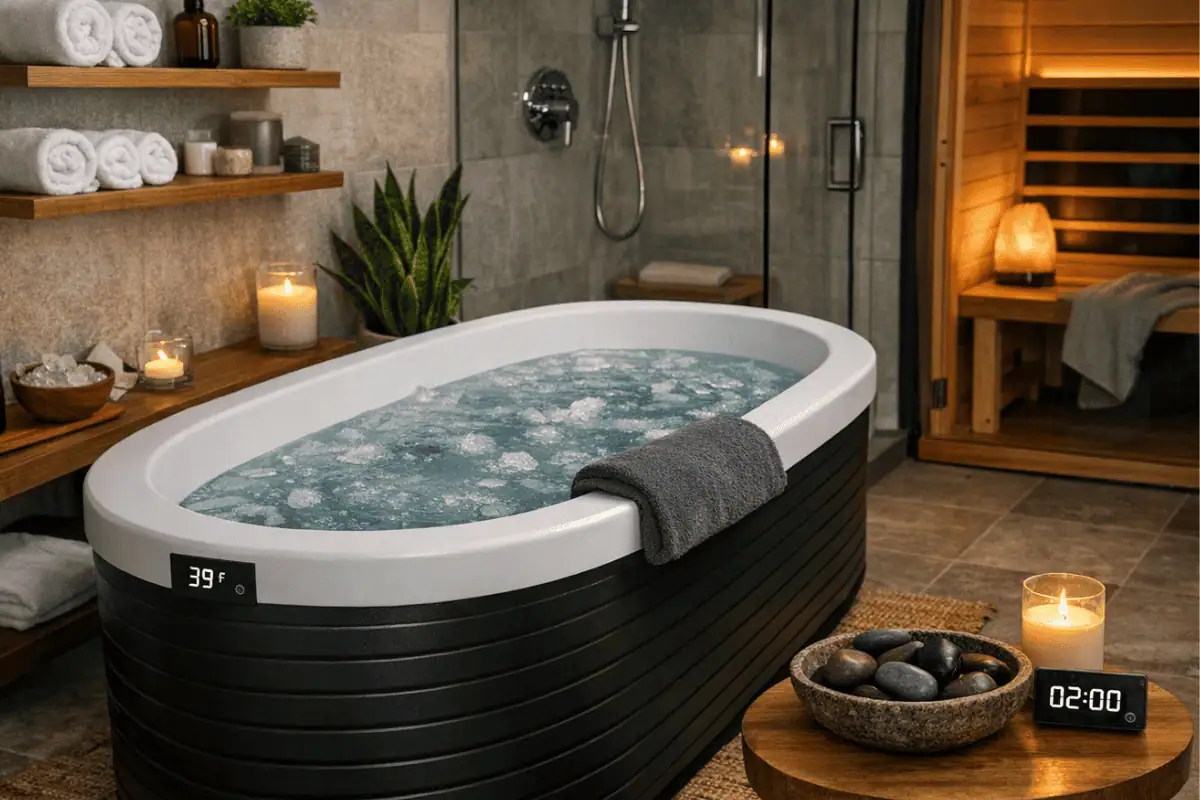
A bathtub cold plunge uses a standard residential bathtub filled with cold tap water, often supplemented with ice. Unlike engineered cold plunge tubs, bathtubs are not designed to control or maintain water temperature.
Typical characteristics include:
- Manual filling and draining
- No active chilling system
- Minimal insulation
- Limited body submersion depth
This setup can expose the body to cold water, but exposure consistency varies widely based on plumbing, ambient temperature, and ice availability.
It helps to think of a bathtub plunge as a single-session, owner-managed setup rather than a system you “set and forget.” Every variable that matters (water temperature, time to cool, ice volume, comfort, cleanup) is controlled manually, and that manual nature is exactly why the experience can be inconsistent from one day to the next.
One practical way to evaluate “bathtub viability” is to separate the setup into three layers:
- Water source layer (tap temperature, seasonality, how quickly the tub fills)
- Cooling layer (ice strategy, optional pre-cooling, how long the water stays cold)
- Immersion layer (body position, water depth, entry/exit safety)
If one layer is weak (for example, warm tap water in a mild climate), the overall experience will likely be less “cold plunge” and more “cool bath,” even if you put meaningful effort into the other layers.
Another constraint is tub design. Many modern tubs are shallow or ergonomically shaped for comfort, which can reduce total water volume and make it harder to submerge areas like the upper back and shoulders. For some users, that changes the perceived intensity and makes repeatable comparisons difficult.
Finally, most bathtubs are located indoors. That’s a convenience advantage, but it also means the surrounding air is usually warm. Warm air speeds heat gain at the water surface, which can shorten the window where the water feels meaningfully cold.
Temperature Reality: How Cold Does a Bathtub Get?

Most residential tap water ranges between 50–60°F depending on location and season. Ice can temporarily lower this, but temperature rises quickly once immersion begins.
Research indicates that many physiological responses associated with cold immersion occur below approximately 59°F, with stronger responses as temperatures drop further (PubMed).
Because bathtubs lack insulation and circulation, maintaining a consistent target temperature is difficult, especially for sessions longer than a few minutes.
In practice, there are two separate “temperature questions” that matter in a bathtub setup:
- Starting temperature (how cold the water is at the moment you get in)
- Staying temperature (how quickly the water warms during your session)
Bathtubs can sometimes reach a cold-enough starting temperature in winter months or in colder regions, but “staying cold” is the harder part. Without insulation, the tub absorbs heat from the room, and without circulation the temperature can become uneven (colder near ice clusters, warmer around the torso).
Ice strategy also matters because ice does not cool water instantly or uniformly. If ice is added and you enter immediately, you may experience pockets of colder water near the ice and warmer water elsewhere. If you wait too long, the bath may become more uniform but also warmer overall depending on room temperature and how quickly the ice melts.
A conservative way to think about it is: a bathtub plunge is most likely to be “cold enough” when you can reliably reproduce a cold starting temperature across multiple sessions. If you cannot reproduce the starting temperature without an extreme ice load, the setup may be too inconsistent for structured protocols.
From a physiology perspective, the initial phase of cold exposure often drives the most noticeable sensations: strong cold shock, involuntary breath changes, and rapid alertness. Those responses can still happen in a bathtub. The question is whether the exposure is consistent enough for you to track adaptation over time (for example, needing less time to regain calm breathing across sessions).
Heat transfer from the body is also significant. The body will warm the surrounding water, and because a bathtub has no active cooling, there is no mechanism to counterbalance that warming. This is one reason why short sessions can feel “effective” early on but become less intense quickly.
If you want to evaluate a bathtub plunge fairly, measure or estimate the temperature at the start and immediately after the session. If the water temperature increases quickly, your “dose” of cold exposure is likely front-loaded, which can make longer sessions feel easier without necessarily providing a stronger cold stimulus.
Body Position, Comfort, and Coverage

Bathtubs are built for reclining, not upright immersion. This affects which body areas are exposed and how evenly cold stimulus is applied.
Common limitations include:
- Shoulders and upper chest remaining above water
- Knees or hips bent awkwardly
- Inconsistent exposure between limbs
For short exposure, this may be tolerable. For structured cold plunge routines, it can limit repeatability.
Comfort and coverage are not just “luxury” considerations. They affect whether you can reliably repeat sessions, especially if your goal is a consistent routine rather than a one-off challenge.
In a dedicated plunge tub, posture is usually upright, which typically makes it easier to keep the torso evenly submerged. In a bathtub, the posture often becomes a compromise: you either recline and accept partial coverage, or you try to sit upright and deal with limited space and awkward angles.
Coverage also tends to change within the same session. People slide, adjust, or brace, which can shift exposure from one limb to another. That movement is normal, but it makes “repeatability” harder if you’re trying to compare experiences week-to-week.
Another practical consideration is entry and exit mechanics. A cold plunge tub is often designed with stable steps or a wide lip. A bathtub can be slippery, narrow, and enclosed. If you are shaky from cold shock, exit safety becomes a bigger issue, especially in bathrooms with tile or hard surfaces.
One conservative framework is to ask:
- Can you enter and exit safely without rushing?
- Can you hold a stable posture without bracing painfully?
- Can you achieve similar coverage across sessions?
If the answer is consistently “no,” the bathtub may still be usable, but it should be treated as a limited exposure tool rather than a long-term training environment.
Finally, water volume matters. Smaller water volume tends to warm faster, which can reduce session intensity over time. Shallow tubs, narrow tubs, or tubs with contoured interiors can unintentionally reduce volume and speed warming during immersion.
Physiological Response in a Bathtub Setup

Initial cold shock, rapid breathing, and heart rate changes can still occur in a bathtub setup, particularly during first exposures.
The sympathetic nervous system responds to sudden cold via vasoconstriction and increased alertness (Cleveland Clinic).
However, because temperature often rises quickly, sustained exposure effects may be shorter-lived compared to controlled systems.
It can be helpful to separate “physiological response” into phases:
- Cold shock phase (first 10–60 seconds): breath disruption, rapid alertness, perceived intensity spikes
- Stabilization phase (next 1–3 minutes): breathing becomes more controllable, sensations become more predictable
- Adaptation phase (over weeks): reduced panic response, faster stabilization, improved tolerance to cold sensation
A bathtub setup can deliver the early cold shock phase reliably if the water is sufficiently cold at the start. Where bathtubs are less reliable is supporting a consistent stabilization phase, because warming can occur quickly and unevenly.
That matters for two reasons. First, some people use cold exposure for “nervous system training,” meaning practicing calm breathing under stress. If the water warms too quickly, the stress stimulus may not be stable enough to train against. Second, some people use cold exposure for recovery rituals where repeatability is the goal. Inconsistent water conditions make repeatability harder.
Cold exposure can also cause skin sensations such as burning, tingling, or numbness. In a bathtub, these sensations may be more localized because of uneven temperature distribution. It’s common to feel one limb “colder” than the other if ice clusters on one side of the tub.
If you are tracking adaptation, a conservative marker is how quickly you regain normal breathing after entry, not how long you can force yourself to stay in. Inconsistent tub conditions can blur that marker, because sessions may feel easier simply due to warmer water rather than improved tolerance.
Safety Considerations Specific to Bathtubs

Bathtub cold plunges introduce safety considerations that differ from outdoor or dedicated tubs.
- Slipping hazards when entering or exiting
- Rapid temperature fluctuation
- Limited space to adjust posture
Medical authorities recommend caution for individuals with cardiovascular conditions or circulation issues (Mayo Clinic).
In addition to general cold exposure cautions, bathtubs add an environment-specific risk profile:
- Hard surfaces (tile and porcelain increase fall injury risk)
- Confined space (less room to stabilize if dizzy or breathless)
- Wet-floor hazard (water overflow or dripping increases slip risk)
Cold shock can briefly impair coordination. That does not mean cold plunging is inherently unsafe, but it does mean entry and exit should be treated as a “high attention” moment rather than a casual step. This is especially relevant if you are doing a bathtub plunge alone.
Another conservative approach is to keep early sessions short and structured rather than pushing duration. Short sessions can still produce a strong cold shock response, and shorter exposure reduces the chance of impaired coordination during exit.
If you are uncertain about contraindications, the safest approach is to treat cold immersion as optional and consult a clinician for individualized guidance. This is particularly relevant for people with known heart conditions, uncontrolled blood pressure, or fainting history.
Hygiene and Maintenance Reality
Bathtubs are easy to drain, but they are not designed for repeated cold immersion sessions.
Common hygiene challenges include:
- Soap residue interacting with cold water
- Biofilm buildup if not cleaned frequently
- Inconsistent water quality between sessions
While cold slows bacterial growth, it does not eliminate sanitation requirements.
For bathtub plunges, hygiene tends to become a “routine” issue rather than a one-time setup issue. The tub may look clean but still hold residue from soap, shampoo, or household cleaners that can irritate skin or create film in the water.
Because bathtub plunges typically use fresh water each session, the sanitation burden is not the same as a recirculating system. However, repeated exposure can still lead to residue buildup on tub surfaces, especially if the tub is not rinsed and dried consistently after cold sessions.
A practical, conservative hygiene framework for bathtub plunges is:
- Before session: quick rinse to remove obvious residue
- After session: drain fully, rinse surfaces, and allow to dry
- Weekly: deeper cleaning to reduce biofilm risk
Water quality also depends on the source. Municipal water typically contains disinfectants, but that does not replace cleanliness of the tub surface. If multiple people share the same tub for cold sessions, the hygiene standard should be stricter.
In a dedicated plunge system, filtration and sanitation tools are often part of the ownership model. In a bathtub, you are relying on frequent drain-and-refill plus surface cleaning. That approach can work, but only if the routine is consistent.
Bathtub vs Dedicated Cold Plunge Tubs
The main difference is control. Dedicated cold plunge tubs offer temperature stability, insulation, and ergonomics designed for immersion.
Bathtubs prioritize convenience and cost but sacrifice consistency.
For a structured comparison, see the Best Cold Plunge Tubs Buyer’s Guide.
Who a Bathtub Cold Plunge Is Best For
A bathtub cold plunge may be appropriate for:
- Curious beginners testing cold exposure
- Occasional use rather than daily routines
- Situations where space or budget is limited
It is less suited for users seeking precise protocols or long-term performance tracking.
One of the most useful ways to decide whether a bathtub plunge fits your goals is to match the setup to your primary intent:
- Experimentation intent: “I want to feel what cold immersion is like and see how I respond.”
- Routine intent: “I want a repeatable protocol I can do multiple times per week.”
- Performance intent: “I want measurable consistency around temperature, duration, and recovery outcomes.”
Bathtub plunges tend to work best for experimentation intent. They can also work for routine intent if your home environment supports it (cold tap water, adequate tub size, and a safe entry/exit setup). They are typically least aligned with performance intent because temperature and posture are hard to standardize.
Another practical filter is time and friction tolerance. A bathtub plunge can be low-cost, but it can be high-friction:
- Filling time
- Ice sourcing and storage
- Cleanup and drying
- Bathroom scheduling if the household shares the tub
If the friction is too high, consistency usually drops. For many people, consistency is the main factor that determines whether cold exposure becomes a habit or a short-lived experiment.
If you are trying to build a stable routine, it may also help to review safety and usage considerations on Cold Plunge Safety & Usage and to contact the site if you want help selecting a long-term option via Contact.
Common Myths About Bathtub Cold Plunges
Myth: Ice makes it equivalent to a professional tub.
Reality: Ice lowers temperature briefly but does not maintain it.
Myth: Short, uncomfortable sessions are always better.
Reality: Duration, temperature, and consistency all matter.
How Beginners Typically Progress From Bathtubs
Many users start with bathtubs and later transition to dedicated tubs after identifying limitations.
This progression mirrors patterns seen in other forms of recovery equipment adoption.
Educational resources like the Cold Plunge Benefits page help contextualize expectations.
Practical Alternatives to Bathtub Cold Plunges
Alternatives include:
- Stock tanks (editorial-only)
- Portable insulated tubs
- Chiller-based systems
Each option balances cost, control, and long-term usability differently.
Final Verdict: Is a Bathtub Cold Plunge Worth It?
A bathtub cold plunge can introduce cold exposure, but it comes with meaningful limitations in temperature control, comfort, and consistency.
For experimentation or occasional use, it may be sufficient. For structured cold plunge routines, purpose-built systems offer clearer advantages.
Next steps often involve understanding how dedicated tubs differ in design and outcomes.
If you continue with a bathtub setup, prioritize safety, repeatability, and realistic expectations around temperature control.
Explore structured options
See how dedicated systems compare. View the Buyer’s Guide →
