
Understanding Cold Plunge Benefits
Cold plunge therapy—also referred to as cold water immersion—involves brief exposure to cold water, typically ranging from cool to very cold temperatures. Interest in cold plunge benefits has expanded rapidly across athletic recovery, mental resilience, and general wellness communities.
This page explains what cold plunge therapy can realistically support, what effects are commonly observed, and where scientific evidence is strongest. Our goal is clarity over hype, helping readers understand both the potential upsides and the boundaries of what cold exposure can do.
For a full overview of how cold immersion fits into a structured routine, see what cold plunge therapy is and how it is typically practiced.
It also helps to separate acute effects (what happens during and immediately after a cold plunge) from adaptive effects (what may change after repeated, consistent exposure). Many of the sensations people associate with cold plunge benefits—alertness, a shift in mood, a sense of “reset”—are closely tied to the body’s short-term stress response and the recovery phase that follows.
Individual response varies based on water temperature, immersion depth, duration, and baseline health. The same protocol that feels manageable to one person may feel overwhelming to another. For that reason, this page describes trends and mechanisms rather than promising specific outcomes.
Nervous System Activation and Stress Resilience
One of the most immediate cold plunge benefits is its effect on the nervous system. Cold exposure activates the sympathetic nervous system, triggering alertness, faster breathing, and an increase in heart rate.
Over time, repeated exposure is associated with improved autonomic regulation—specifically, the body’s ability to shift efficiently between stress and recovery states. This is often described as improved stress tolerance rather than stress elimination.
A useful way to think about this is that cold exposure provides a controlled, time-limited stressor. The “training” effect comes from learning to move through the initial cold shock response (rapid breathing, tension, urgency to exit) and then allowing the body to downshift once the exposure ends. For many people, the perceived mental benefit is less about the cold itself and more about practicing calm, steady breathing under stress.
It is also common for early sessions to feel disproportionately intense. The initial 15–45 seconds can produce strong respiratory drive and skin discomfort, even when the overall session is brief. With gradual exposure and consistent practice, many people report that the same temperature becomes more tolerable over time, which aligns with acclimation patterns described in cold exposure research.

Research summarized by the National Institutes of Health suggests cold exposure influences norepinephrine release, which may contribute to improved focus and perceived mental clarity without functioning as a medical treatment.
In practical terms, the “mental clarity” people describe is often short-lived and context-dependent. It may be most noticeable when cold immersion is paired with consistent routines (sleep, nutrition, training load management) rather than treated as a standalone solution.
For a deeper breakdown of how cold exposure interacts with stress signaling and recovery states, you can explore our more focused page on cold plunge and stress.
Related reading: Cold plunge and the nervous system.
Inflammation Reduction and Physical Recovery
Cold plunge therapy is commonly used after intense physical activity due to its association with reduced short-term inflammation. Cold temperatures cause vasoconstriction, temporarily narrowing blood vessels and slowing inflammatory signaling.
It is important to keep expectations realistic. Reduced soreness is not the same as accelerated tissue repair, and “feeling recovered” does not always mean the underlying training stress has fully resolved. In practice, cold plunging may help some people feel more comfortable returning to activity sooner, especially when soreness would otherwise limit movement quality.

According to reviews indexed in PubMed, cold water immersion may help reduce delayed-onset muscle soreness (DOMS) in certain contexts. However, it is not universally recommended for muscle growth phases due to possible interference with hypertrophy signaling.
This makes cold plunge benefits context-dependent—often helpful for recovery phases, competition periods, or high training volumes.
A conservative approach is to treat cold immersion as a recovery tool rather than a daily default. If the primary goal is performance maintenance and reduced soreness, cold plunging after the most demanding sessions may be more appropriate than using it after every workout.
If strength or muscle gain is the top priority, some athletes choose to separate cold plunging from resistance training by several hours (or reserve it for rest days). This timing strategy is discussed in sports medicine contexts because inflammation is not always “bad”—it is part of the signal that supports adaptation.
Circulation and Cardiovascular Adaptation
Cold exposure prompts a rapid circulatory response. Blood is redirected from the skin toward the core to protect vital organs. After exiting the cold, vasodilation occurs, increasing blood flow back to peripheral tissues.
In healthy individuals, repeated cold exposure may improve comfort with temperature shifts and reduce the intensity of the initial “shock” response over time. However, the cardiovascular load during immersion is real. Cold water exposure can increase heart rate and blood pressure, especially during sudden entry or intense cold shock.

The Cleveland Clinic notes that this vascular “exercise” may support circulatory efficiency in healthy individuals. It is not a treatment for cardiovascular disease and should be avoided by those with certain heart conditions unless medically cleared.
Because cold exposure can raise blood pressure during immersion, it is especially important for anyone with known cardiovascular risk factors to approach cold plunging conservatively. Shorter duration, warmer temperatures (cool rather than extreme), and gradual entry are common safety-first adjustments.
For healthy individuals, many of the perceived circulation-related benefits are most likely to show up as improved tolerance to temperature changes and a smoother transition from cold to normal skin sensation—not as a medical outcome.
Sleep Quality and Parasympathetic Rebound
Some individuals report improved sleep quality when cold plunging earlier in the day. This may be related to parasympathetic rebound following the initial stress response.
Another practical factor is rewarming. If someone stays cold for too long after immersion, it may increase stimulation or discomfort. Gentle rewarming, dry clothes, and allowing the body to normalize can make the overall experience more recovery-oriented.
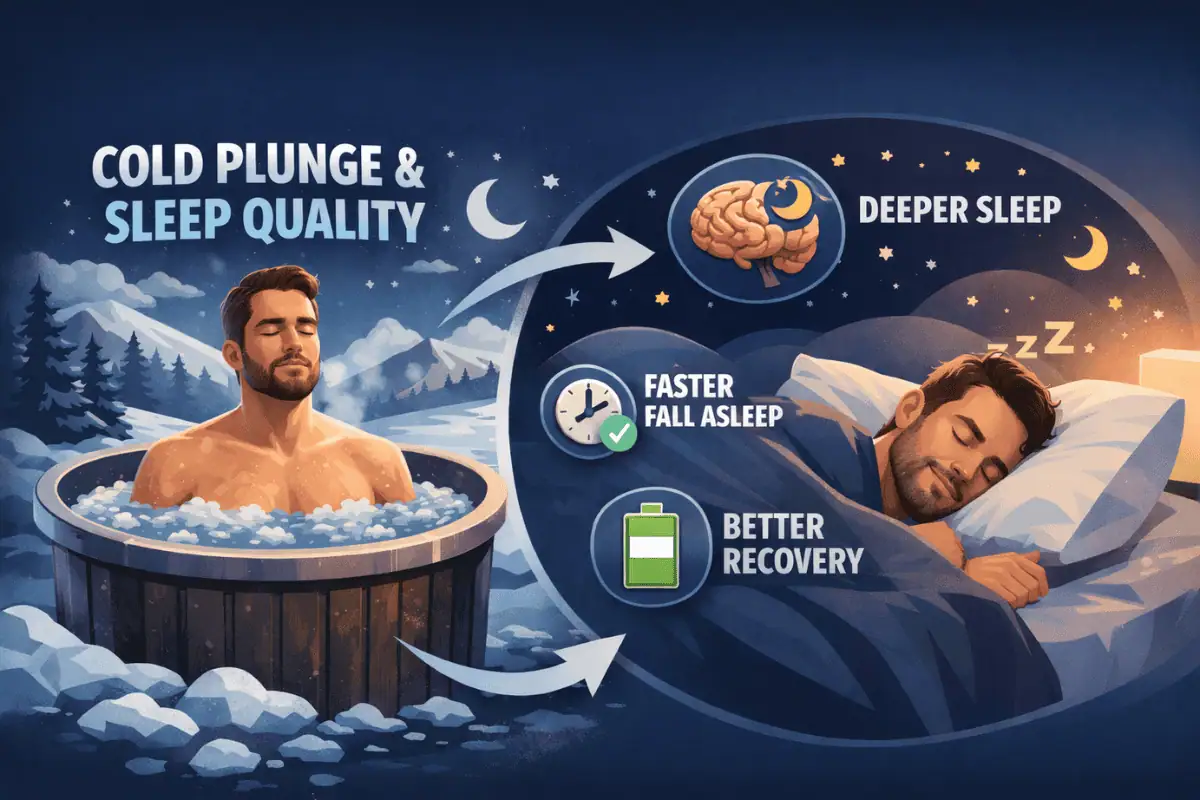
The Mayo Clinic emphasizes that timing matters. Late-night cold exposure may be stimulating rather than calming for some people. Individual response varies widely.
See also: How cold plunge affects sleep.
A conservative guideline many people follow is to finish cold exposure at least a few hours before bedtime, then allow the body to warm back up naturally. If cold plunging is used specifically for sleep support, it is usually approached as a daytime routine (morning or early afternoon) rather than a nighttime intervention.
It can also be helpful to separate the “feel-good” calm after a plunge from actual sleep architecture. Feeling relaxed does not always translate to deeper sleep, and any sleep-related benefit should be interpreted as a possible supportive effect, not a guarantee.
Metabolic Effects and Brown Fat Activation
Cold exposure has been shown to stimulate brown adipose tissue (BAT), a metabolically active fat that generates heat. This process increases short-term energy expenditure.
BAT activity is one reason cold exposure is often linked to metabolic discussion. When the body must generate heat, energy demand increases, and cold adaptation can influence how efficiently the body responds to temperature stressors. These mechanisms are real, but the practical impact varies and is typically modest.
Studies cited by the PubMed database suggest repeated cold exposure may modestly improve insulin sensitivity in some populations. These effects are incremental and should not be viewed as a weight-loss intervention.
More detail is covered in cold plunge and metabolism.
From a conservative perspective, metabolic cold plunge benefits are best seen as a potential “small lever” rather than a primary strategy. If body composition or metabolic health is the goal, fundamentals like dietary quality, daily movement, resistance training, and sleep are likely to matter far more than cold exposure alone.
It is also common for people to notice appetite changes after cold exposure. Some feel temporarily less hungry; others feel hungrier later in the day. These responses are individual and can be influenced by total stress load and energy balance.
If your primary interest is metabolic support, it can help to think in terms of consistency and tolerable intensity. Extreme protocols are not necessary to potentially stimulate adaptive responses, and overly intense exposure can increase stress load in a way that undermines recovery behaviors.
Setting Realistic Expectations
Cold plunge benefits are best understood as adaptive responses—not instant fixes. The body responds to controlled cold exposure by improving resilience, recovery signaling, and stress regulation over time.
Cold plunge therapy is not appropriate for everyone. Individuals with cardiovascular conditions, uncontrolled hypertension, or cold sensitivity should review safety considerations on our Cold Plunge Safety & Usage page.
If you’re considering integrating cold immersion into a structured routine, explore our Best Cold Plunge Tubs Buyer’s Guide for practical comparisons and setup considerations, or browse related topics in the Plunge Sage blog.
A practical way to apply this information is to start with conservative exposure: shorter duration, less extreme temperatures, and a focus on steady breathing. If the goal is recovery support, consider using cold immersion selectively after the hardest training days rather than treating it as mandatory. If the goal is stress resilience, prioritize consistency and controlled intensity over pushing extremes.
Most importantly, treat any benefit as something to evaluate over time. If cold plunging consistently worsens sleep, increases anxiety, or feels unsafe, that is useful feedback. The “best” approach is the one that fits your health profile, your routine, and your recovery capacity.