Cold Plunge Frequency Guide: How Often to Cold Plunge for Recovery, Health, and Adaptation

Cold plunge frequency is one of the most common—and most misunderstood—questions in cold water immersion. Many people assume that more is better, but cold exposure is a physiological stressor that requires recovery, adaptation, and context.
This guide explains how often to cold plunge based on recovery goals, general health, and long-term adaptation, using conservative, science-aligned principles. There is no single “perfect” schedule—only ranges that make sense for different bodies and objectives.
Why Cold Plunge Frequency Matters

Cold plunging activates the sympathetic nervous system, triggers rapid vasoconstriction, and elevates heart rate and breathing. These responses are normal—but they also represent stress.
Frequency determines whether cold exposure:
- Supports adaptation and resilience
- Enhances recovery between training sessions
- Or accumulates excessive stress without adequate recovery
Research summarized by the National Institutes of Health shows that adaptation occurs when stress is applied intermittently—not continuously. This same principle applies to cold exposure.
A practical way to think about frequency is to treat cold exposure like a “dose.” The dose is not just how often you plunge—it also includes how cold the water is, how long you stay in, and how intense the entry feels. If frequency increases while temperature and duration stay aggressive, the overall dose can become difficult to recover from.
Frequency also determines what your body is actually learning. Early sessions often emphasize respiratory control and cardiovascular regulation under sudden cold stress. If sessions are too frequent before you adapt, you may repeatedly experience a strong shock response instead of gradually building tolerance and control.
Cold plunge frequency should also be considered alongside your broader stress load:
- Training volume and intensity
- Sleep quality and schedule stability
- Work and life stress
- Caloric restriction or low-carb phases
When these stressors rise, a conservative adjustment is to reduce cold plunge frequency rather than pushing through. This is one reason a “set it and forget it” schedule can fail—what works in a calm week may be too much during a high-demand week.
If you want additional cold-plunge education beyond this guide, you can browse our full library on the Plunge Sage Blog index.
Cold Plunge Frequency for Beginners

For beginners, cold plunge frequency should prioritize safety, acclimation, and nervous system learning—not endurance.
A conservative starting range:
- 2–3 sessions per week
- At moderate cold temperatures
- With short durations
This allows the body to learn how to regulate breathing and heart rate during cold exposure. The Mayo Clinic emphasizes gradual exposure when introducing physiological stressors, especially for individuals new to cold or heat therapies.
For many beginners, the first milestone is not “staying in longer.” It’s being able to enter the water, regain calm breathing, and exit feeling steady rather than shaky or over-stressed. A lower frequency supports this learning process by leaving room for recovery and nervous system normalization between sessions.
A simple beginner framework is to choose non-consecutive days (for example: Monday/Wednesday/Friday). This spacing helps prevent cold sessions from stacking on top of each other before your body has had time to adapt.
A conservative progression principle is to change only one variable at a time. For example, keep frequency stable for 2–3 weeks, then choose one adjustment:
- Add one additional session per week, or
- Slightly increase duration, or
- Slightly lower temperature
Beginners often run into trouble by increasing frequency, duration, and cold intensity simultaneously. If your goal is long-term adaptation, gradual changes are typically easier to sustain and easier to evaluate.
If you want a conservative “green/yellow/red” approach for beginners:
- Green: 2 sessions/week (easy recovery, steady sleep, stable mood)
- Yellow: 3 sessions/week (still stable, but monitor sleep and energy)
- Red: 4+ sessions/week early on (often unnecessary unless the dose is very mild)
This is not a medical rule—just a practical decision logic that helps prevent early overuse.
Cold Plunge Frequency for Recovery and Training

Athletes and physically active individuals often use cold plunges to manage soreness and perceived fatigue.
Typical recovery-focused frequency:
- 3–5 times per week
- Often after intense training days
- Not necessarily after every workout
Some research indexed on PubMed suggests that excessive cold exposure immediately after strength training may blunt hypertrophy signaling. This makes frequency and timing more important than sheer consistency.
A conservative athlete-focused framework is to match cold plunge frequency to training demand rather than forcing daily exposure. Many athletes do best when cold sessions cluster around the highest stress days and taper during lighter weeks.
Examples of recovery-aligned frequency strategies include:
- High-intensity weeks: 4–5 plunges/week (with milder dose per session)
- Moderate weeks: 3–4 plunges/week
- Deload or low-stress weeks: 2–3 plunges/week
This approach reduces the risk of cold exposure becoming “extra training” for the nervous system when your body is already under load.
If strength and muscle growth are a primary goal, some people choose to avoid cold immersion immediately after lifting sessions and instead place cold exposures:
- Later in the day, after normal post-training nutrition and rewarming
- On separate days from heavy resistance training
- After conditioning sessions where recovery comfort is the limiting factor
This timing strategy is not required for everyone, but it shows why frequency decisions should include the context of training goals.
If you are unsure how to align frequency with your training style, you can use a “minimum effective dose” mindset: start with fewer weekly sessions, then add only if you see clear recovery benefits without sleep disruption or persistent fatigue.
Daily Cold Plunging: Is It Necessary or Helpful?

Daily cold plunging is popular on social media, but it is not required for benefits—and may not be appropriate for everyone.
Potential concerns with daily frequency include:
- Accumulated nervous system fatigue
- Sleep disruption in sensitive individuals
- Blunted stress response over time
According to guidance from the Cleveland Clinic, daily exposure to intense stressors should be evaluated in the context of recovery, sleep quality, and overall health.
If someone does choose a daily pattern, it generally works best when the overall dose is reduced. In practical terms, “daily” often needs to mean:
- Shorter sessions
- Less extreme water temperatures
- Higher emphasis on calm breathing and smooth exits
Another conservative option is a “5–2” model: cold plunges on weekdays with two rest days per week. This can preserve routine consistency while still building in recovery.
It may also help to separate “cold practice” from “cold plunge.” Some people benefit from daily cold exposure habits (like brief cool showers) while keeping true cold plunges to 2–4 times per week. This can maintain the psychological rhythm of daily consistency without turning high-intensity cold immersion into a daily stress requirement.
How Adaptation Changes Cold Plunge Frequency

As adaptation occurs, the body becomes more efficient at regulating temperature, heart rate, and breathing during cold exposure.
This can allow:
- Slightly increased frequency
- More consistent routines
- Reduced perceived shock
However, adaptation does not eliminate the need for recovery. Stress physiology still applies—even when the experience feels easier.
Adaptation also tends to be specific to your current “dose.” If you increase frequency and also drop temperature, you may feel as if you “lost” adaptation when, in reality, you increased the stress input. That is why conservative progress usually works best with one variable change at a time.
A simple phase model can help with planning frequency:
- Acclimation phase (weeks 1–3): lower frequency, prioritize calm breathing and safe exits
- Stabilization phase (weeks 4–8): maintain frequency, keep dose consistent, track sleep and energy
- Maintenance phase (months 3+): flexible frequency based on training cycles and life stress
Many people also benefit from occasional “deload weeks” where frequency drops for 5–7 days. This is not required, but it can be a conservative reset if you notice creeping fatigue or sleep disruption.
Signs You May Be Cold Plunging Too Often
Cold plunge frequency should be adjusted downward if you notice:
- Persistent fatigue or low motivation
- Difficulty warming up after sessions
- Disrupted sleep patterns
- Loss of appetite or irritability
These signals suggest the nervous system may be under-recovering. Reducing frequency often restores balance within one to two weeks.
It can help to watch for patterns rather than isolated “bad days.” For example, if sleep quality declines for several nights in a row after increasing frequency, that is a useful signal that the current dose may be too high.
More conservative indicators that frequency may be too high include:
- Cold sessions begin to feel progressively harder rather than easier
- You feel “wired but tired” after plunges instead of calm and steady
- Rewarming takes longer and leaves you feeling drained
If you have questions about how to adjust your routine safely, you can reach us via the Plunge Sage Contact page.
Cold Plunge Frequency and Long-Term Health
For general health and wellness, moderate consistency tends to outperform extremes.
Most evidence-aligned routines fall between:
- 2–4 sessions per week
- Maintained over months or years
- Adjusted during illness or high stress
This aligns with broader stress-adaptation frameworks described in public health literature from institutions like the NIH.
A conservative long-term goal is to choose a frequency you can maintain without relying on willpower. If your routine is so intense that you regularly dread it or feel depleted afterward, it may not be sustainable—even if it is “effective” in the short term.
Long-term consistency also tends to improve decision-making: with a stable routine, it is easier to notice when a change in sleep, stress, or training load requires a temporary frequency adjustment.
Frequency vs Temperature and Duration
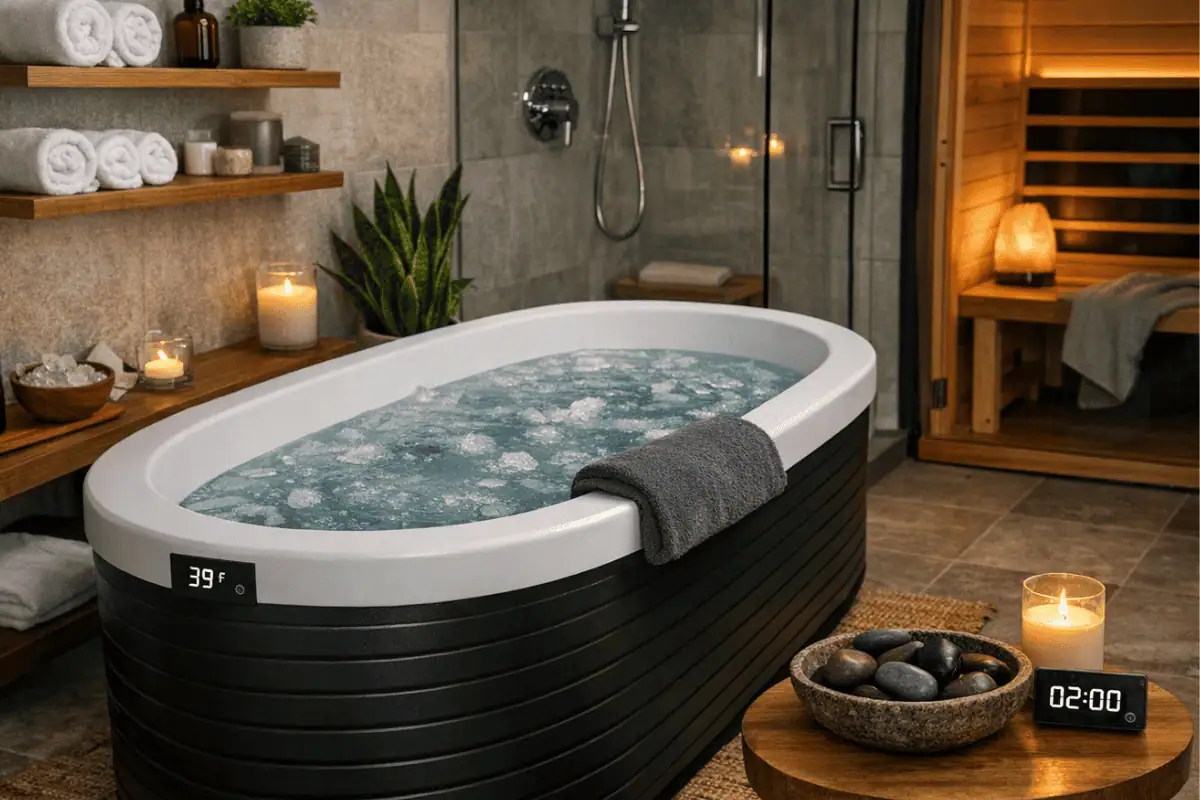
Cold plunge frequency cannot be separated from temperature and duration.
Higher frequency often requires:
- Slightly warmer water
- Shorter immersion times
- More deliberate breathing control
Lower frequency allows colder temperatures or longer exposures without excessive cumulative stress.
This is where “ownership reality” matters for frequency. The more often you plunge, the more important it becomes that your setup supports consistent water temperature and reasonable maintenance. For example, if your routine relies on hauling ice daily, the real-world burden can push you toward either inconsistency or overuse when you do plunge (“I got the ice, so I should stay longer”).
A conservative practical framework is:
- If your setup is high effort (ice + manual filling), consider 2–4 sessions/week as a sustainable target.
- If your setup is lower effort (stable temperature control), you may be able to maintain 3–5 sessions/week without the same logistical friction.
This does not mean a chiller-based setup is “necessary.” It simply highlights that frequency decisions are not purely physiological—they are also behavioral and logistical. A routine you can actually maintain tends to outperform a theoretically perfect routine you cannot execute consistently.
How to Build a Sustainable Cold Plunge Schedule
A sustainable cold plunge routine balances stress and recovery.
Helpful guidelines:
- Start with fewer sessions
- Increase frequency gradually
- Track sleep, energy, and mood
For a broader foundation, see our overview of cold plunge benefits.
If you want a conservative schedule template, here are a few examples that many people can sustain:
- Beginner template: 2–3 sessions/week on non-consecutive days
- General wellness template: 3 sessions/week plus flexibility during stressful weeks
- Recovery template: 3–5 sessions/week, aligned to higher training-demand days
The most important step is to pick a baseline schedule and hold it steady long enough to evaluate it. Frequent changes can make it difficult to tell whether frequency is helping or creating additional strain.
When to Reduce or Pause Cold Plunging
Temporary reduction is appropriate during:
- Illness or fever
- Major sleep deprivation
- Periods of high psychological stress
Cold exposure should support resilience—not override recovery signals.
A conservative approach is to treat cold exposure like training: when your system is already taxed, you reduce intensity and volume. If you do maintain cold exposure during a stressful period, it may be reasonable to reduce the dose (shorter sessions, less frequent sessions, or milder temperatures).
Choosing the Right Setup for Your Frequency Goals
Higher-frequency routines benefit from:
- Reliable temperature control
- Easy access and setup
- Consistent water quality
Our Best Cold Plunge Tubs Buyer’s Guide compares systems designed for regular use.
Even for non-commercial routines, a “good fit” setup often comes down to how well it supports the frequency you want. If access is inconvenient or maintenance is overwhelming, frequency tends to become inconsistent. If access is easy and the routine feels manageable, frequency can remain stable without forcing it.
Conclusion: Finding Your Ideal Cold Plunge Frequency
Cold plunge frequency is not about maximizing discomfort—it is about applying stress in a way the body can adapt to over time.
Most people thrive with moderate, consistent exposure that supports recovery, health, and resilience. Start conservatively, adjust based on response, and prioritize long-term sustainability.
For equipment, setup considerations, and comparisons, explore our complete Buyer’s Guide to Cold Plunge Tubs.
If you want a deeper look at related cold exposure topics, you can explore additional guides in our Blog index.
